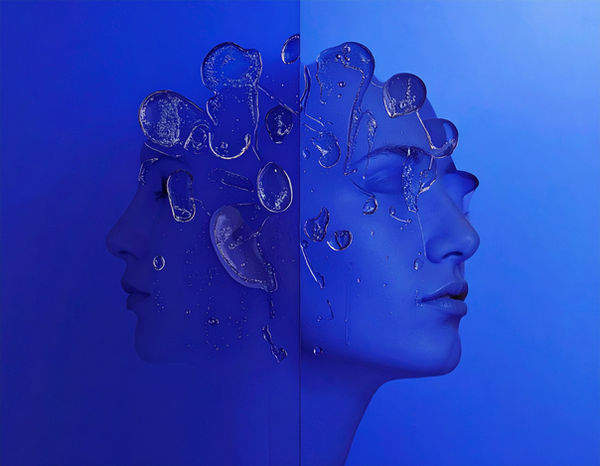
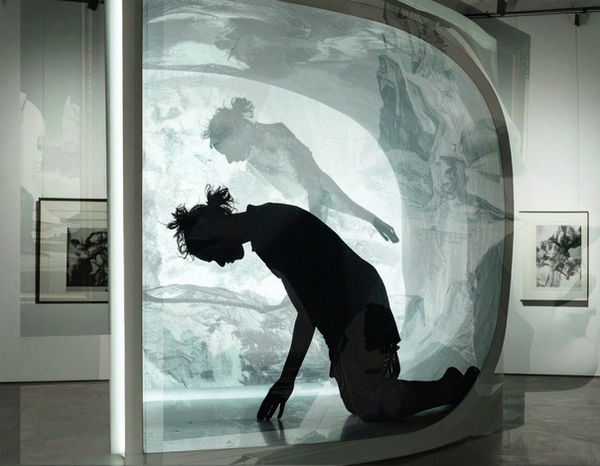
1,500 algorithmically rendered iterations. Most vanish into invisibility.
What remains are residues—moments where the stochastic machinery produces something that escapes prior intention. I feed the system indexical traces (photographs, drawings); it responds with fields of variation. Selection happens afterward, as retroactive recognition.
The concept: blocking images. Not as psychoanalytic repression, but as interference patterns in how we see.
They don't invite—they arrest. An imperceptible membrane halts the habitualized consumption of images. They don't block perception itself, but automated seeing, that trained pattern-matching which immediately converts images into something exploitable. You collide with them.
The emerging faces: hybrids in partial decomposition, slightly mycotic. They refuse identification. What appears is a subject in terminal crisis — eroded from within by the neoliberal demand for singularity, encrusted from without by algorithmic sedimentation. The same subject grasping for authenticity in selfie filters and registering the uncanny in AI-generated portraits — without understanding both are identical outputs of the same apparatus of visibility.
Theory operates here as a lighting condition, an epistemic environment under which objects change their contours. It enables temporary suspension of the image operation—that permanent circulation imperative converting all visuality into value, affect, identity. In this pause, quiet astonishment emerges. Not toward hidden depth, but toward radical flatness itself. Toward the marvelous indifference with which generative machinery processes morphological combinations.These images are not semantic vehicles. They are operators in a game with one rule: positing.
After exhaustive deconstruction, after complete disillusionment with metaphysical anchors, what remains is the minimal, nearly arbitrary act of installing something into the space of visibility. The machine generates 1,500 variations. I select one. That is the gesture.In this infinitesimal decision—transitioning from virtual infinity to singular actualization—something like aura recurs. Not as mystical substance, but as indexical trace of decision within statistical noise.
This portfolio is an accumulation of interruptions. An invitation to pause and register the plastic surface of the habitual.
To continue, possibly with recalibrated perception, through the omnipresent iconosphere from which our present is constructed. The astonishment itself—without teleological aim, without promise of resolution—is sufficient.